Overview
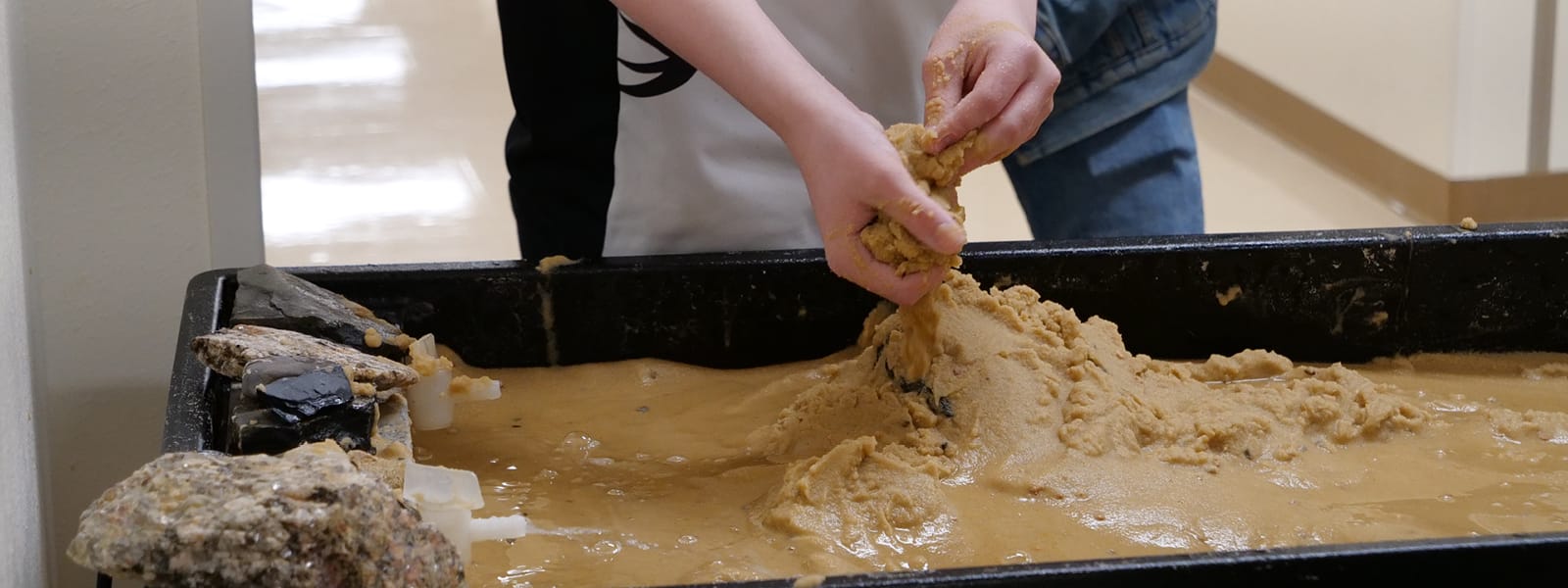
The Bachelor of Science in Education - Composite Science Education with Earth Science Track is a major within the School of Applied Sciences. If you have questions regarding this program, please contact dsu.hawk@dickinsonstate.edu or call 1-800-279-HAWK.
Degree Requirements:
- General Education Courses
- Major Courses
- Secondary Professional Education Courses
Student Learning Outcomes
A student successfully completing the Composite Science Education major will be able to:
- Integrate knowledge from various scientific disciplines (i.e., biology, chemistry, earth science, physics) to address real-world problems and appreciate the interconnectedness of the scientific disciplines. (This learning outcome directly addresses Institutional Learning Outcomes III and VII.)
- Design a valid scientific experiment and analyze the resulting data. (This learning outcome directly addresses Institutional Learning Outcomes III, IV, V, VI, and VI.)
- Read, interpret and evaluate information presented in media ranging from public news sources to scientific papers. (This learning outcome directly addresses Institutional Learning Outcomes III and VIII.)
- Accurately communicate scientific ideas in written and oral form. (This learning outcome directly addresses Institutional Learning Outcomes III and VII.)
- Demonstrate an awareness of major global scientific issues and appreciate the interconnectedness of the global system. (This learning outcome directly addresses Institutional Learning Outcomes III, VII, and X.)
Career Options
Why should you pursue a Bachelor of Science in Education Degree - Composite Science Education: Earth Science Track?
The earth science track of this bachelor’s degree in composite science education prepares students to become middle school and high school science teachers. This is an especially good choice for students who want to teach in smaller communities where they will be teaching many of the sciences. Be prepared to teach earth science, but also have a strong enough background to teach biology and chemistry as well.
Possible Career Paths
- Middle School Science Teacher
- High School Science Teacher
Requirements
Composite Science Education Earth Science Track
Students in the Composite Science Education (Earth Science Track) major are required to take MATH 107 as their Group IIB General Education requirement. If MATH 107 is not taken as the IIB GE requirement, it must be taken to fulfill the requirements of the degree program.
In order to graduate, a grade of “C” or better is required in courses taken in fulfillment of a natural sciences degree or minor as well as ENGL 110, ENGL 120 and COMM 110.
Select one of the following:
| SOIL 321 | Soil Management and Conservation | 3 |
| SOIL 322 | Soil Fertility and Fertilizers | 3 |
| SOIL 350 | Soil Health and Productivity | 3 |
| SOIL 444 | Soil Genesis and Survey | 4 |
| Total Credit Hours: | 3-4 |
Semester Sequence
First Semester
Second Semester
Third Semester
Fourth Semester
| BIOL 375 | Environmental Economics, Law and Public Policy | 3 |
| EDUC 280 | Education of Exceptional Learners | 3 |
| EDUC 300 | Teaching For Diversity | 3 |
| EDUC 398D | Diversity and Exceptionalities Field Experience | 1 |
| GEOL 106 | The Earth Through Time | 3 |
| GEOL 106L | The Earth Through Time Lab | 1 |
| GEOL 320 | Hydrogeology | 3 |
| Total Credit Hours: | 17 |
Fifth Semester
| EDUC 405 | Educational Psychology | 2 |
| EDUC 406 | Instructional Design, Technology and Assessment | 3 |
| SCNC 389 | Scientific Writings and Readings | 2 |
| SOIL 210 | Introduction to Soil Science | 4 |
| SEED 398B | Secondary Education Methods Block Practicum I | 1 |
| SEED 490S | Secondary Education Science Methods | 3 |
| Total Credit Hours: | 15 |
Sixth Semester
Seventh Semester
Eighth Semester